
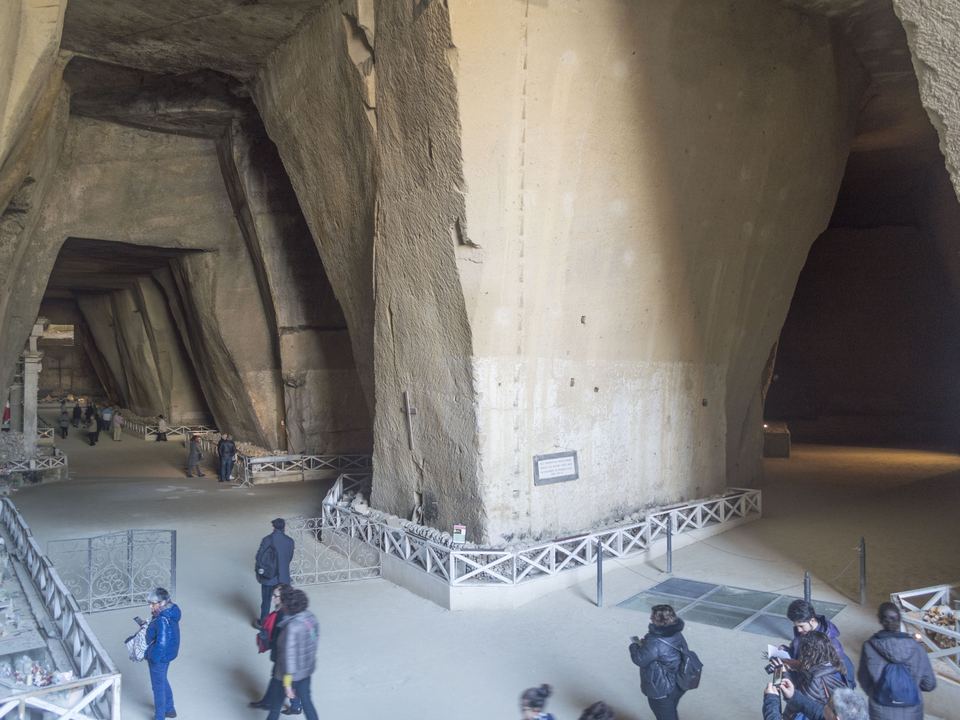
Cimitero delle Fontanelle
- Hidden Gem
- Historic Site
- Price: €6 - €8
- Opening hours: 10:00 - 18:00, Mon & Fri from 09:00 (closed Wed)
Book a guided tour of Napoli
Skip the line and see Napoli with a local guide.
History
The caves take their name from the small springs, or fontanelle, that once ran through this stretch of the Materdei hill, whose soft volcanic tuff had already been quarried for building stone since Greek and Roman times. That excavated space took on a very different purpose in 1656, when a violent plague epidemic swept through Naples, killing so much of the population within a matter of months that ordinary burial practice broke down entirely and the dead were carried here in overwhelming numbers. A second wave of mass burials followed the cholera epidemic of 1836, which claimed thousands more lives across the city, adding a further layer of unclaimed and unidentified remains to those already resting in the quarries.
For more than two centuries the bones lay largely without order, until 1872, when the priest Don Gaetano Barbati, helped by local women, undertook to arrange them into three symbolic sections, set aside respectively for clergy, for plague victims and for the pezzentelle, the destitute and unnamed dead, and opened the site to public devotion. It was this ordering, as much as the burials themselves, that gave the cemetery its distinct character: a place where Naples' poor dead, stripped of names and individual graves, were nonetheless given a kind of collective care that continued for generations afterward.
Did you know?
One skull, known locally as "the captain" for the battle-like wounds visible on the cranium, became one of the cemetery's most storied capuzzelle: local tradition holds it to be a jealous guardian of its own devotion, and tells of a young bride said to have mocked it not long before misfortune struck her own wedding. Stories like this one, passed down rather than documented, show how thoroughly the anime pezzentelle folk cult wove itself into the everyday imagination of the Sanità district, well beyond anything the Church ever formally sanctioned.
That informality is precisely what drew official concern: in 1969 the Church moved to curb devotional practice at the site, worried that the adoption of skulls had drifted into superstition, and public access for worship was restricted not long after. The cemetery nonetheless never fully lost its hold on local memory, with visits continuing on and off in the decades that followed, and its return in 2026 under a permanent, managed footing, reframed for visitors while still setting aside time for quiet prayer, reflects an attempt to honour both the site's heritage value and its ongoing meaning to the neighbourhood.
Good to know
Since reopening in April 2026, the cemetery has operated by mandatory advance booking only, through the official cimiterodellefontanelle.it portal; standard opening hours run 10:00-18:00 with last entry at 17:15, and the site closes on Wednesdays. On Mondays and Fridays it opens earlier, at 9:00, to set aside time for local worshippers before general visits begin, worth knowing if you'd rather visit outside the busiest hours.
The cemetery sits an easy walk from the Catacombs of San Gennaro and San Gaudioso, and pairing the three makes for a full, if sobering, morning or afternoon in Rione Sanità; the neighbourhood's Palazzo dello Spagnolo and Ponte della Sanità are both nearby if you want to lighten the mood afterward. Because the site remains one of continued local devotion rather than a curiosity to gawk at, visitors are expected to keep their voices low and behave as they would in any place of quiet remembrance.