
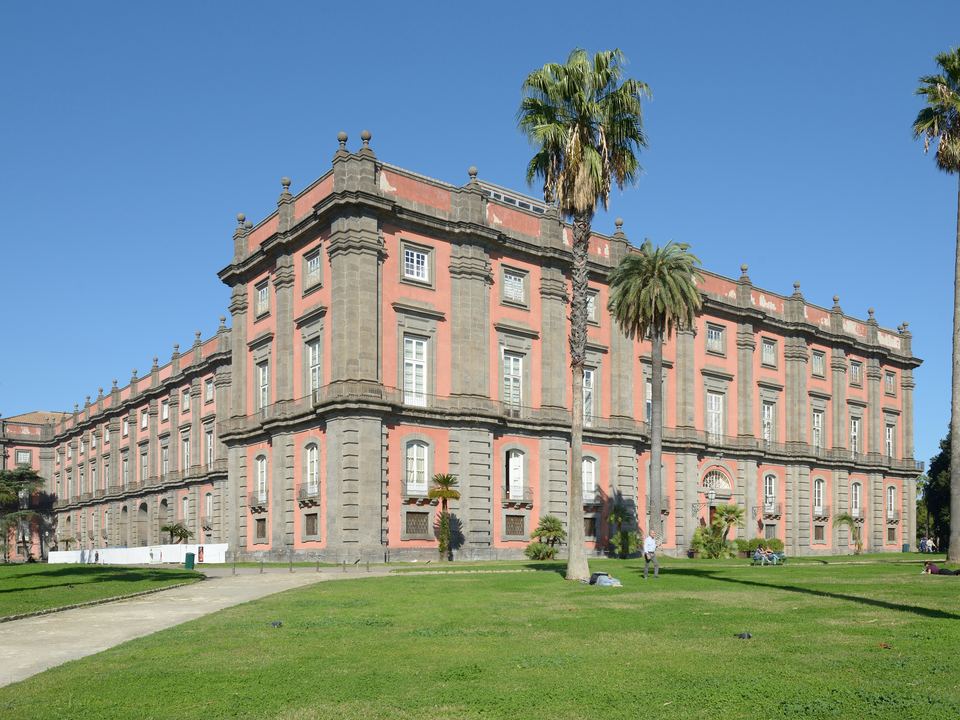
Museo di Capodimonte
- Art Museum & Gallery
- Historic Palace
- Price: €2 - €10
- Opening hours: Thu-Tue 08:30-19:30, closed Wed
History
The palace's origins trace to 1738, when Charles VII of Naples — later Charles III of Spain — set out to build a hunting lodge amid the woods above the city, only to expand the plan almost immediately into a full royal palace, driven in large part by the need to house the Farnese art collection that had come to him through his mother, Elisabetta Farnese, after the direct male line of the Farnese dukes of Parma died out in 1731. Five years after construction began, in 1743, Charles and his wife, Maria Amalia of Saxony, founded a royal porcelain manufactory on the grounds, determined to rival the Meissen porcelain her family already produced in Saxony.
The palace remained a royal residence for the best part of two centuries, passing from the Bourbons to the House of Savoy after Italian unification, and it was not formally inaugurated as a public museum until 5 May 1957, when Italian President Giovanni Gronchi opened it under state management. The reorganisation split the old Farnese inheritance between two Neapolitan institutions: the bulk of the antique sculpture went to what became the Museo Archeologico Nazionale downtown, while Capodimonte kept the paintings, drawing together the Renaissance core of the collection with later royal acquisitions and gifts under one roof on the hill.
Did you know?
Titian's Danaë, painted for the Farnese family in the mid-1540s, has a wartime history nearly as dramatic as its subject: in 1943, along with dozens of other Neapolitan masterpieces evacuated for safekeeping to the abbey of Monte Cassino, it was seized by a division under Hermann Göring's command and reportedly hung for a time in his private quarters. The painting surfaced two years later in a salt mine at Altaussee, in the Austrian Alps, where retreating German forces had stockpiled looted art, and Italian recovery efforts eventually returned it to Naples in 1947.
The palace's porcelain apartments preserve the Salottino di Porcellana, a small boudoir room covered in more than 3,000 individually moulded porcelain pieces, made for Queen Maria Amalia's private rooms at the royal palace of Portici between 1757 and 1759 in a lavish chinoiserie style. When the Bourbon properties passed to the new Kingdom of Italy in 1866, the entire room was dismantled piece by piece and reassembled at Capodimonte, where it still occupies its own gallery among the historic apartments.
Good to know
The museum opens Thursday to Tuesday from 8:30 to 19:30, with last admission an hour before closing, and is closed on Wednesdays; standard tickets fall in the €2-10 range depending on age and EU residency, and the surrounding park is free and open daily even outside museum hours. Because the picture galleries alone run to more than a hundred rooms, allowing at least half a day makes for a more comfortable visit than trying to see everything in a rushed hour or two.
The more than 130-hectare Real Bosco di Capodimonte around the museum is one of the best places in Naples for a quiet walk, and several of its paths open onto views back over the rooftops to the bay and Vesuvius, particularly rewarding in the late afternoon light. The hill sits a short taxi or bus ride from the historic centre rather than in easy walking distance, so it pairs naturally with a full day devoted to the museum and park rather than a quick stop between other sights such as San Lorenzo Maggiore or the Archaeological Museum.