
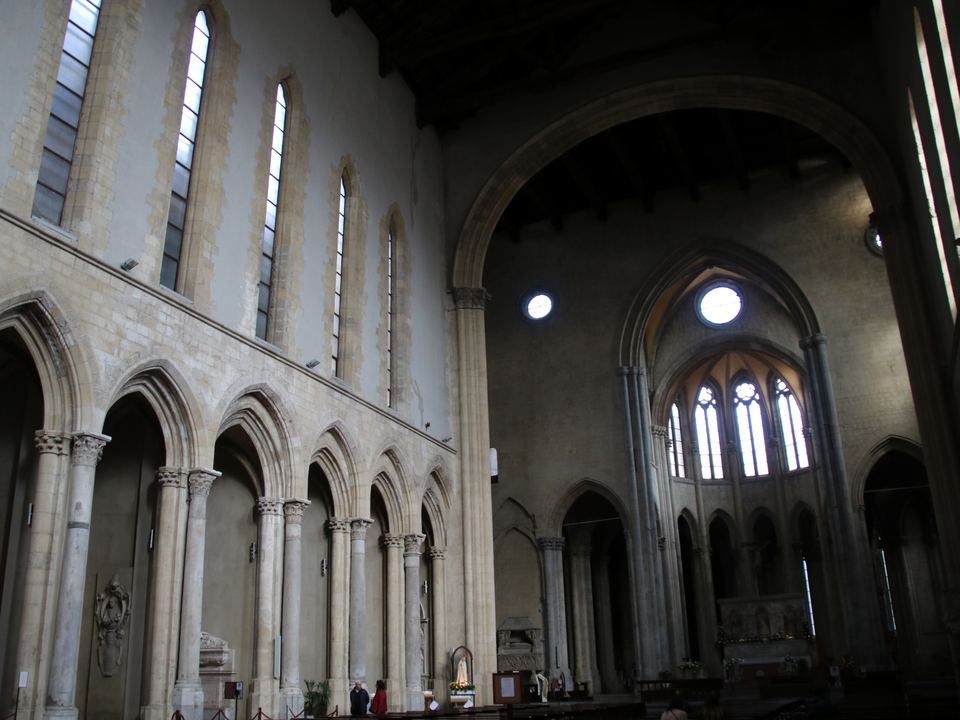
Basilica of San Lorenzo Maggiore
- Church & Religious Site
- Archaeological Site
- Price: €6 - €9
- Opening hours: 09:30 - 17:30
History
Long before Charles I of Anjou funded the present church, a sixth-century basilica already stood on the site, founded under Bishop John II of Aversa and raised over the ruins of the ancient Greek agora and the Roman market that once served it. When rebuilding began around 1270, partly to mark the consolidation of Angevin rule in the kingdom, Charles brought in French master masons whose chevet — ringed by radiating chapels — remains one of the purest expressions of French Gothic architecture south of Rome. Among the church's oldest surviving furnishings is the canopy tomb of Catherine of Austria, who died in 1323; it was the first Neapolitan commission of the Sienese sculptor Tino di Camaino, who would go on to shape court sculpture in Naples for a generation.
The convent's chapter hall, raised above the cloister, doubled for centuries as a de facto seat of city government, hosting sessions of the Neapolitan parliament formed by the city's noble and popular seggi. It was here, in 1442, that Alfonso V of Aragon — known as the Magnanimous, having just wrested Naples from the last Angevin claimant — had his son Ferrante publicly acknowledged as heir, a ceremony that helped cement the Aragonese succession for the following half-century. Nearly a century earlier, in 1345, the poet Petrarch had lodged in the same Franciscan convent, drawn to a community that by then already counted literary pilgrims among its regular guests.
Did you know?
Although antiquarians had long guessed that a Roman forum lay beneath the church, systematic excavation of the buried macellum did not begin until the late 1970s, and the work advanced in fits and starts — slowed by funding gaps and, for a time, by the aftermath of the 1980 Irpinia earthquake — before finally concluding in 2009 with European Union support. The excavated market opened to visitors in the early 1990s, meaning that most of what today's visitors walk through spent the better part of the twentieth century as rubble and forgotten shopfronts sealed beneath the church floor.
According to Boccaccio's own later account, it was inside this church, on a Holy Saturday, that he first set eyes on the noblewoman he would immortalize as Fiammetta — traditionally identified with Maria d'Aquino, said to have been a natural daughter of King Robert of Anjou. The encounter, real or embellished in hindsight, seeded a figure who would recur across several of Boccaccio's early works, making a single glance inside San Lorenzo one of the founding moments of Italian vernacular love poetry.
Good to know
The basilica itself can be visited free of charge during regular hours, while a single ticket in the €6-9 range covers both the Roman excavations beneath the cloister and the small site museum tracing the complex's layers from Greek agora to Bourbon Naples; the ticket office keeps the same hours as the site, with last admission shortly before closing. Combined tickets bundling San Lorenzo with a guided visit are also sold online, useful for visitors keen to skip the queue in high season.
The excavations are cool and low-lit year-round, so they make a comfortable midday escape from summer heat, while the church above is best appreciated in the softer light of morning. Piazza San Gaetano, right outside, sits at the heart of Naples' historic centre along Via dei Tribunali, within easy walking distance of the Duomo and, for visitors keen to go even deeper underground, the entrance to Napoli Sotterranea a few steps away on the same square.