
Castel Sant'Elmo
- Castle & Fortress
- Viewpoint & Tower
- Price: €2 - €5
- Opening hours: 08:30 - 19:30 (closed Tue)
History
The hill takes its name from a small medieval church dedicated to Sant'Erasmo, a name Neapolitan dialect gradually wore down to "Sant'Elmo"; the fortified residence built around it, first documented as "Belforte" near the end of the 13th century, was still a modest stronghold when Robert of Anjou had it enlarged into a proper palace-fortress in 1329, using the same architect, Tino di Camaino, then also at work on the Certosa di San Martino taking shape just below on the same hill.
The star-shaped fortress that replaced it under Don Pedro de Toledo in the 1530s and 1540s soon proved its military value: in 1647, during the popular uprising led by the fisherman Masaniello against Spanish rule, the garrison at Sant'Elmo turned its guns downhill onto the crowded Mercato and Porto districts to help suppress the revolt. A century and a half later the fortress changed sides dramatically: in 1799, republican patriots seized it by surprise, raised a Tree of Liberty over its ramparts, and held it as the last stronghold of the short-lived Neapolitan Republic before finally surrendering to the Bourbon-allied Sanfedista forces.
Did you know?
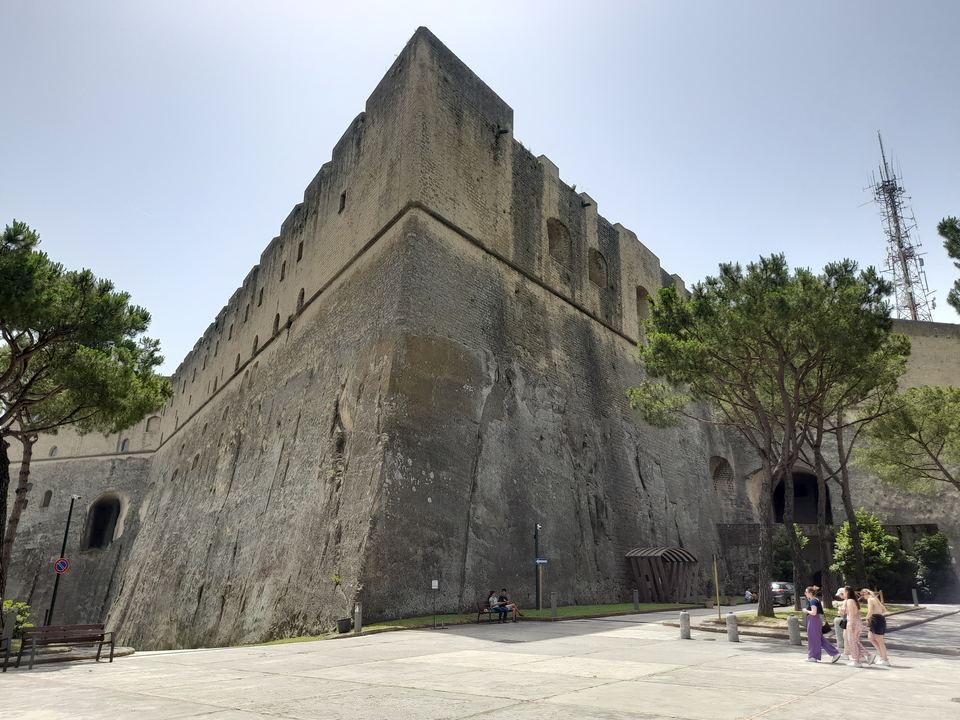
Escrivà's six-pointed star plan wasn't decoration — it was pure military logic, angled so that defenders on any bastion could sweep every approach with crossfire and leave no blind spot for an attacking force to shelter in. Even more striking is what lies beneath: rather than building up a masonry base, engineers cut the fortress's deep dry moat and much of its foundation directly out of the soft yellow tuff rock of the hill, and a network of cisterns and tunnels was later carved into that same rock to store water and move troops and supplies unseen.
Over the centuries the fortress held some of Naples' most stubborn dissidents, among them, according to several historical accounts, the philosopher and heretic Tommaso Campanella, who spent long stretches of his 27 years in Spanish custody shuttled between Sant'Elmo and the city's other castles. After the 1799 republic fell, some of its leading figures — including the magistrate Mario Pagano and the nobleman Gennaro Serra di Cassano — were held here before their executions, a grim final chapter for a fortress otherwise remembered today mostly for its view.
Good to know
Castel Sant'Elmo is open 08:30-19:30 and closed on Tuesdays, with admission priced in the €2-5 range; the easiest way up is the Funicolare di Montesanto to the Morghen stop, a short uphill walk from the entrance, though the Funicolare Centrale (Piazza Fuga) works just as well and both save the steep climb on foot from the historic center below.
Because the Certosa di San Martino sits barely 200 metres away on the same hilltop, most visitors pair the two in a single outing, often taking in the monastery's cloisters and nativity scene before climbing to the fortress for the view. That view is best in the late afternoon, when the sun swings around behind Vesuvius and the light softens over the bay — though the exposed bastions catch real wind even on calm days, so a light jacket is worth having even in warmer months.