
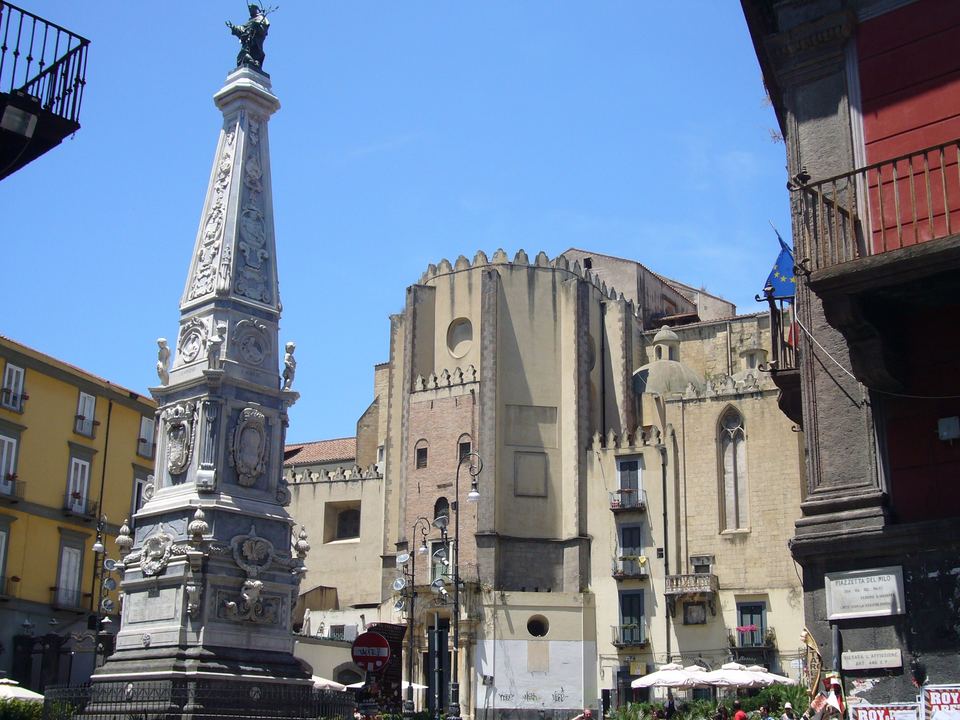
Basilica of San Domenico Maggiore
- Church & Religious Site
- Price: Free
- Opening hours: Mon-Fri 10:00-13:30 & 14:30-17:30, Sat-Sun 10:00-18:00
Book a guided tour of Napoli
Skip the line and see Napoli with a local guide.
History
Charles II of Anjou commissioned the basilica for the Dominican order at the very end of the 13th century, raising it in Gothic style over an earlier church on the same site and largely completing it by the 1320s. It quickly became one of the intellectual centers of the kingdom: the adjoining convent housed a school of theology that drew some of the era's leading minds, and the building was reworked more than once in the centuries that followed, including a thoroughgoing 19th-century neo-Gothic restoration that stripped back later Baroque additions layered on in between.
Thomas Aquinas taught theology in that convent between 1272 and 1274, and tradition holds that it was here, in the small cell that can still be visited, that he experienced the vision that led him to set his writing aside; praying before a crucifix, Aquinas is said to have heard Christ tell him, "You have written well of me, Thomas; what reward would you have for your labour?", to which he replied that he wanted nothing but Christ himself. The 13th-century crucifix associated with the story is preserved in the same cell, with a copy displayed in the church's Chapel of the Crucifix below.
Did you know?
Behind an unassuming door off the church, the sacristy holds around forty-five wooden coffins holding members of the Aragonese royal court and Neapolitan nobility, ranged along the walls beneath a ceiling fresco of the Triumph of Faith over Heresy painted by Francesco Solimena between 1706 and 1709. Not every coffin holds a full body: King Alfonso I's remains were moved to Spain in 1666 leaving his casket empty, while the hearts of several Angevin and Aragonese rulers were removed and preserved separately in silver.
A young Caravaggio painted a Flagellation of Christ for a chapel here belonging to the Carafa family, one of several major commissions he picked up during his turbulent stay in Naples; the original was later taken down and eventually made its way into the collection of the Museo di Capodimonte, and a devotional image known as the Madonna di Zi'Andrea hangs in its place today, so most visitors walk past the spot without realizing a Caravaggio once hung there.
Good to know
The church observes a midday closure on weekdays (10:00-13:30 and 14:30-17:30) but stays open through the afternoon on weekends (10:00-18:00), and entry to the main basilica is free; a separate small fee applies if you want to see Aquinas's cell and the sacristy with its royal coffins, generally arranged through the adjoining museum entrance.
Outside in the square, the Guglia di San Domenico — a Baroque votive spire begun by Cosimo Fanzago in 1656 in thanks for the end of that year's plague, stalled for decades, and only finished by Domenico Antonio Vaccaro in 1737 — makes a good excuse to linger before or after the visit. The church sits a two-minute walk from the Cappella Sansevero, and the two are easily seen back to back along the Spaccanapoli route.