
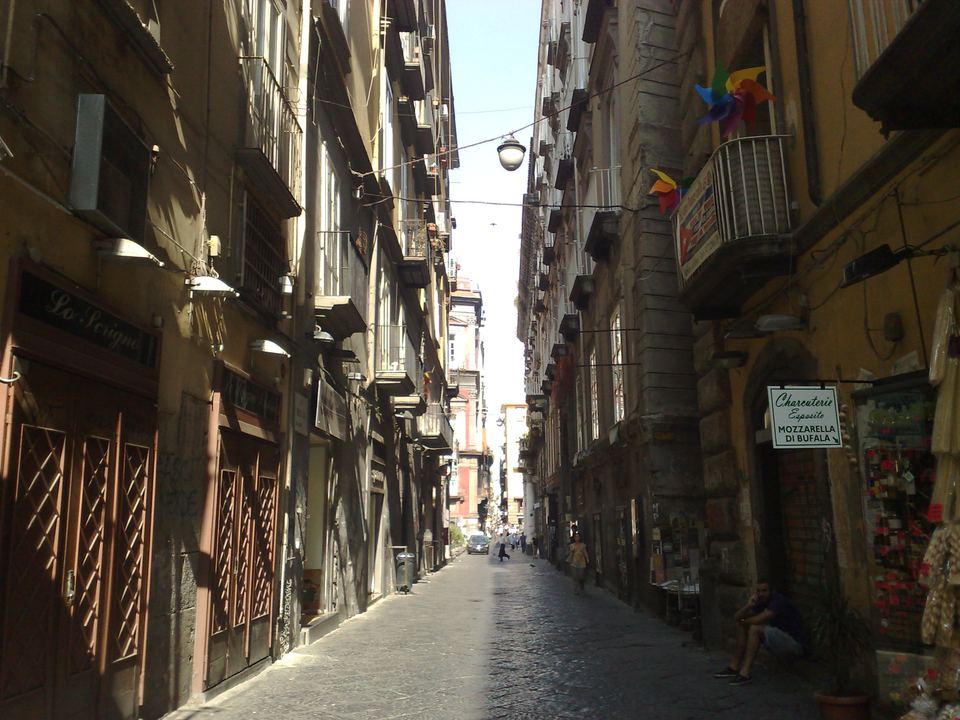
Spaccanapoli
- Historic District
- Price: Free
- Opening hours: Always open
Book a guided tour of Napoli
Skip the line and see Napoli with a local guide.
History
The street belongs to the original grid imposed on Neapolis when Greek settlers refounded the city around 470 BC, laying out three parallel decumani running east-west and crossing them with narrower cardines running north-south; the decumano inferiore that became Spaccanapoli was the southernmost and lowest-lying of the three. What's remarkable is not just the age of that layout but its persistence: the street plan visible on the ground today, block widths and all, still largely traces the grid the Greeks first surveyed roughly two and a half thousand years ago, built over and rebuilt on by Romans, medieval Neapolitans and everyone since, without ever being straightened away.
As the city grew, the street picked up different names along its length rather than keeping one for its full run. It becomes Via Benedetto Croce for its first stretch below Piazza del Gesù Nuovo, named for the philosopher who lived for decades, and died in 1952, at Palazzo Filomarino on this very block, before turning into Via San Biagio dei Librai further along, a stretch long associated with goldsmiths and booksellers whose trade signs still crowd the shopfronts today.
Did you know?
The name Spaccanapoli, "Naples-splitter," was never an official designation; it emerged informally among locals and visitors describing exactly what the street does, and the effect is easiest to appreciate from above, from the terraces of Castel Sant'Elmo or the Certosa di San Martino on the hill of Vomero, where the line cutting the old centre in two stands out sharply against the surrounding roofscape.
Just off the street, the rough-cut stone facade of the church of Gesù Nuovo is in fact recycled masonry from the Palazzo Sanseverino, the noble residence the Jesuits took over and converted into a church at the end of the sixteenth century. The diamond-pointed stone blocks are carved with cryptic incised marks that some researchers have proposed, controversially, to be a form of musical notation, while older local legend simply calls them a secret language of the stonecutters who carved them.
Good to know
There's no admission and no fixed hours; Spaccanapoli is a public street, busiest by day with shoppers, students and market stalls, and busiest by night around Piazza San Domenico Maggiore and the bars near Via San Biagio dei Librai. Along the way it runs directly past the entrances to Gesù Nuovo, the cloistered complex of Santa Chiara and the church of San Domenico Maggiore, with Via San Gregorio Armeno breaking off partway along, so it works well as a spine for a walking route rather than a single stop.
The volcanic stone paving, or basolato, that has carried foot traffic here for centuries is uneven and can be slippery when wet, so comfortable shoes are worth more here than almost anywhere else in the city centre. Early morning offers the clearest view down the street's dead-straight length for photographs, before the crowds and parked scooters fill the frame; by evening, the same stretch turns into one of the liveliest spots in the old town for street food and a slow after-dinner stroll.