
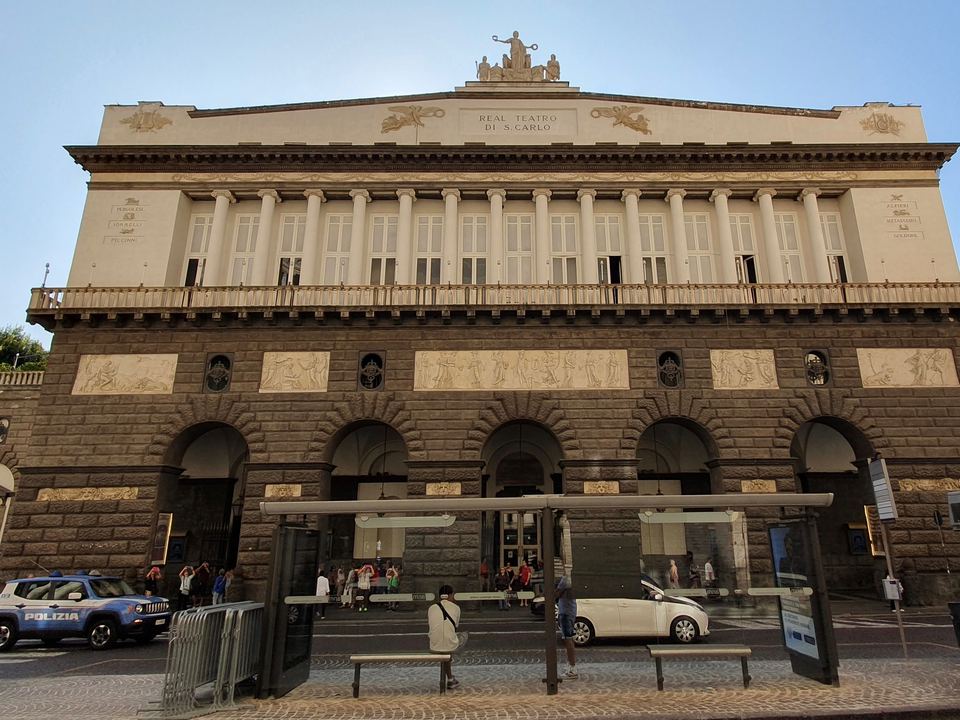
Teatro di San Carlo
- Theatre & Opera House
- Price: €7 - €9
- Opening hours: Guided tours: Mon-Sat 10:30 - 16:30, Sun 10:30 - 12:30
Book a guided tour of Napoli
Skip the line and see Napoli with a local guide.
History
The original theatre was raised in a remarkable eight months, designed by the military engineer Giovanni Antonio Medrano and built under the direction of the impresario Angelo Carasale, on the personal order of King Charles of Bourbon, who wanted his new kingdom to have an opera house worthy of its ambitions. It opened on 4 November 1737, the feast day of Charles's namesake, San Carlo Borromeo, with a performance of Domenico Sarro's Achille in Sciro, and quickly became a reference point for opera houses across Europe, its horseshoe-shaped auditorium and tiers of boxes copied outward from Naples for the rest of the century.
That first building burned to the ground on the night of 12-13 February 1816, when a fire broke out on stage during preparations and spread through the wooden structure before it could be contained. King Ferdinand I refused to let the loss stand, appointing the architect Antonio Niccolini to rebuild it at once; astonishingly, the new theatre — the horseshoe hall, azure-and-gold decoration and grand royal box still seen today — was ready in well under a year, reopening on 12 January 1817, the king's birthday, to replace the ruins with what was by common agreement the most sumptuous theatre in Europe.
Did you know?
The French writer Stendhal was in Naples for that 1817 reopening and left one of the most quoted verdicts on any theatre in Italy: "There is nothing in the whole of Europe that comes close to giving an idea of this theatre," he wrote, adding that a hall rebuilt in three hundred days was itself a kind of political triumph, one that did more for royal popularity than any law could. His account, published in Rome, Naples et Florence, has followed the San Carlo's reputation ever since.
Gioachino Rossini served as the theatre's musical director from 1815 to 1822, right through the fire and rebuilding, and the disruption produced an odd footnote in operatic history: his opera Otello, ossia il Moro di Venezia, premiered on 4 December 1816, not at the San Carlo but at the smaller Teatro del Fondo nearby, since the San Carlo itself was still a burnt-out shell awaiting Niccolini's new building.
Good to know
Outside performance times, the theatre can only be seen on a guided tour, which lasts about 30 minutes and runs several times a day, typically at 10:30, 11:30, 12:30, 14:30, 15:30 and 16:30 Monday to Saturday and a shorter morning schedule on Sundays; most tours are in Italian, with English-language slots usually available around midday and mid-afternoon. Full-price tickets cost around €9, with reductions for groups, students, and visitors over 65, and it's worth booking ahead in high season since access without a valid ticket or an authorised guide isn't permitted.
Standing on Via San Carlo directly across from the Galleria Umberto I and a short walk from Piazza del Plebiscito and the Royal Palace, the theatre fits easily into a single stroll through this part of the historic centre. Photography is generally allowed inside during the guided tour, though flash and tripods are usually restricted, and for anyone with the time, seeing an actual opera or ballet performance remains by far the best way to experience the hall's celebrated acoustics.